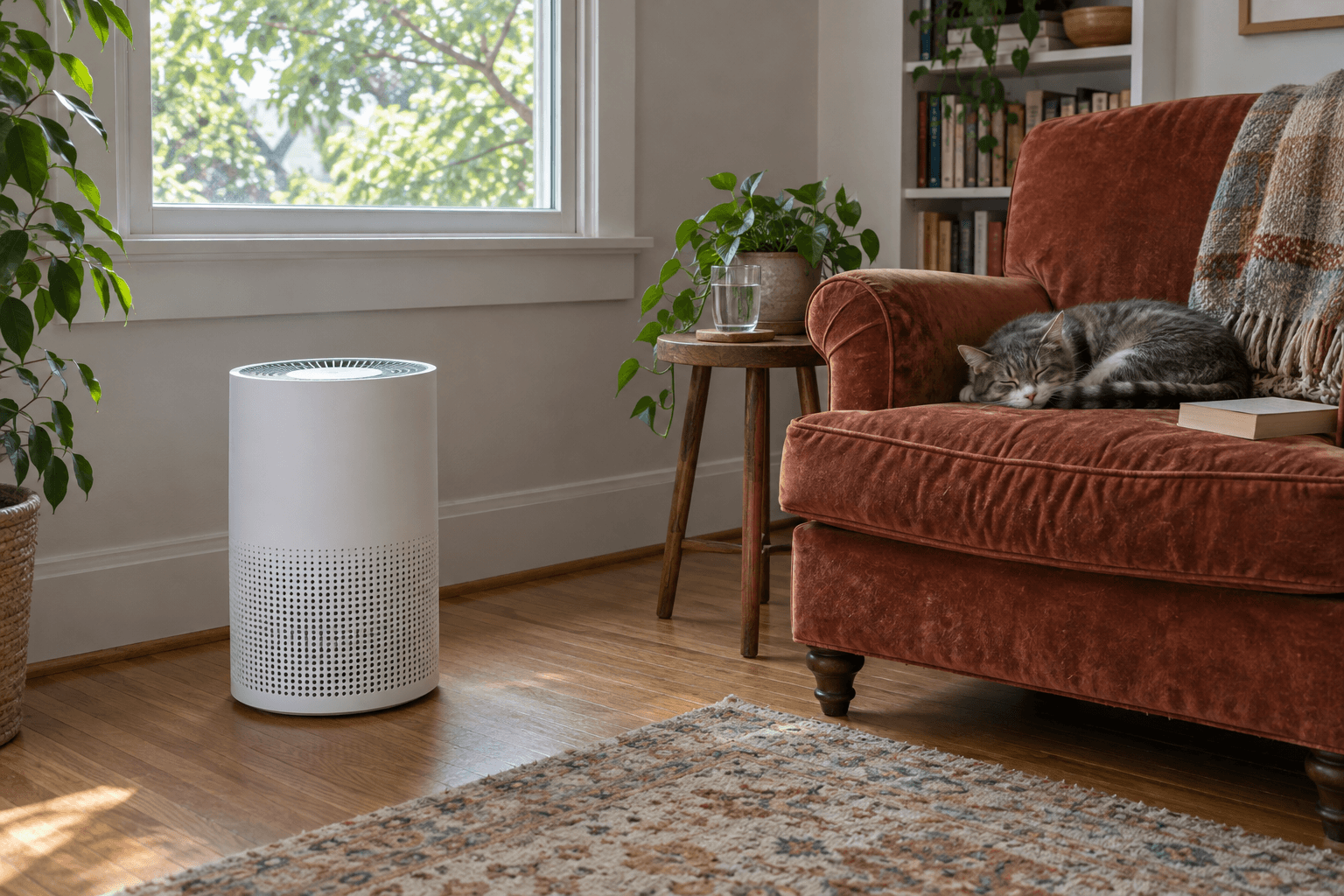
The air cleaner fitted beautifully behind the reading chair. From the doorway I could barely see it. From the cleaner's point of view, however, there was a chair, a curtain and a wall where its air needed to go.
I moved it into the open and discovered the practical problem I should have solved before buying it: how to keep it useful without making the room awkward to walk through.
Start with the manufacturer's clearances
Source: Health Canada: choosing and using a portable air cleaner
Health Canada advises placing a portable cleaner where furniture and other objects will not block airflow. Higher fan speeds and longer operation generally filter more air. The model's instructions determine the specific arrangement around its intake and outlet.
I checked which openings drew air in, which discharged it, and how to reach the filter. We found a position near an outlet without trailing a cord across the doorway.
The spare room would have hidden the machine, but we spent most evenings in the living room. We put it where it would serve that occupied space. We didn't assume one device in a hallway would clean every closed bedroom equally.
A small weekly check
I check that the curtain has not drifted across the intake and that nothing has been set on top. When cleaning is due, I follow the instructions for each filter; a washable prefilter does not mean every layer can be rinsed.
The quieter nighttime setting is a deliberate tradeoff in airflow. If that setting cannot meet the intended room's needs, placement alone will not fix the sizing.
We continue to manage indoor sources and ventilate when outdoor conditions allow. The air cleaner has a useful role without becoming the answer to every air-quality concern.
The chair moved slightly too. It still faces the window, and now both the person reading and the machine beside them have enough room.