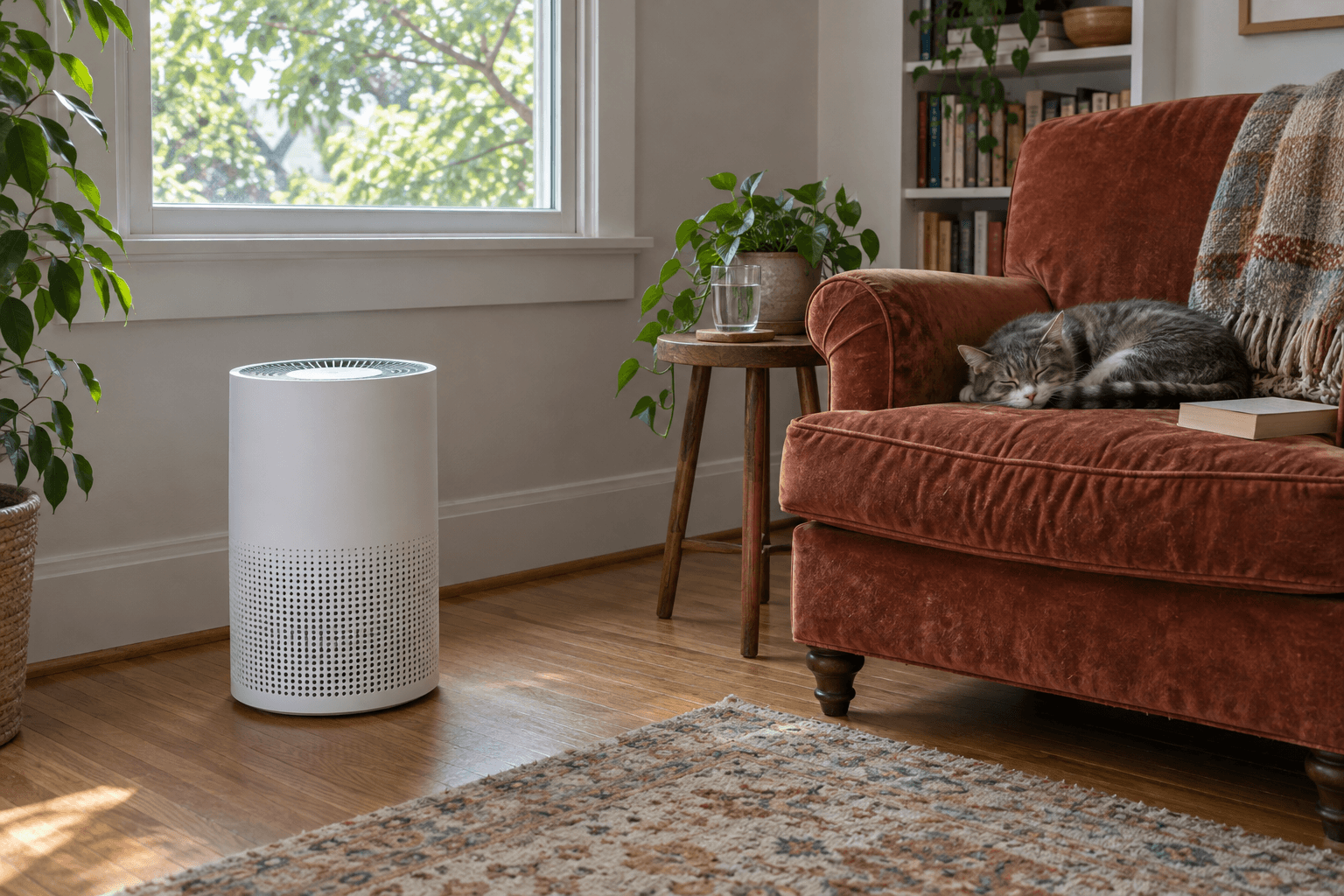
I nearly bought an air cleaner by matching its white case to the bookcase. Then I measured the living room, including the open area beside the stairs, and realized that the product photo told me very little about the job.
The cleaner would have to run while we talked, read and watched television. A machine that only suited the room on a setting we immediately turned down deserved a second look.
Use the room and the clean-air rating
Source: Health Canada: choosing and using a portable air cleaner
Health Canada recommends checking the suggested room size and clean air delivery rate, or CADR. Its general minimum for tobacco-smoke CADR is two-thirds of floor area in square feet for an eight-foot ceiling. Higher ceilings need more capacity. Smoke CADR is relevant to fine particles, including wildfire smoke.
I measured the intended space and compared certified ratings, fan speeds and noise information. An open-plan layout made a single small-room label a poor fit for the whole floor.
HEPA describes a filter, while delivered clean air also depends on how much air passes through it. I wanted the unit's performance information, replacement-filter availability and ongoing filter cost.
Make the operating plan part of the purchase
I checked the required clearances before ordering. There had to be a usable position near an appropriate outlet, away from traffic and with room for intake and discharge.
I avoided ozone-producing devices. I also kept the claim narrow: particle filtration does not remove every gas, replace ventilation or make a carbon monoxide alarm unnecessary.
We chose a room we use often and a setting we could tolerate for long periods. If another bedroom needed its own cleaner, that would be a separate sizing decision.
The tape measure stayed on the table throughout the comparison. It was a more useful shopping accessory than the photograph of our bookcase.